Author Archive
apricots, Boneless Center Cut Pork Chops, chutney, cognac, ginger, mangoes, Pork, the other white meat
In General Articles on August 9, 2011 at 6:37 PM
In 1987, pork producers in the USA along with their industry association, The National Pork Board, and their advertising/public relations firm, conceived of a brilliant marketing strategy designed to increase consumer acceptance of their product. Pork® The Other White Meat® was the brand that they developed and introduced in a nationwide PR campaign.
Historically, pork had been looked upon as being a fat-laden product, as compared to chicken, particularly skinless breast meat. Although pork consumption appears to have remained fairly steady since the start of the campaign, at least through 2004, beef consumption has declined, while chicken consumption continues to rise.
Besides having a lower fat content than most cuts of beef, processed pork (primarily boneless chops) and processed chicken (primarily boneless, skinless breasts) have another aspect in common, in my opinion. Both are basically bland and boring. Their redeeming feature is that they benefit from a variety of sauces, herbs and spices to make them enjoyable. See our recipe for Pork Chops Braised in Calvados, Caramelized Apples and Raisins.
Pork marries very well with many different fruits. Thinking about this and finding fresh, ripe mangoes in the market the other day, we remembered that we still had some boneless, center-cut, pork chops in the freezer. An inspection of the pantry revealed a jar of apricot preserve and a bottle of cognac, fresh ginger is usually on hand as well. So thinking about all of this, we came up with the idea of Broiled Pork Chops with Apricot-Mango Chutney. Grilled pork chops, which surely would have been just as delicious, were not possible that evening due to a torrential rain storm. So check out the recipe and let us know what you think.

bowtie pasta. ham, carbonara, cream, parmesan cheese, peas
In For Moms on the Go, Pasta, Recipes on August 8, 2011 at 11:07 AM
Recipes from “Moms on the Go” are starting to come in. Here’s one from our daughter. A “Mom on the Go” with one child and another due to arrive any day now.
Ingredients:
1 pound bowtie pasta
3 tablespoons sweet butter
1 small white onion, diced, about 1/2 cup
1/2 cup frozen or shelled fresh peas
2 tablespoon water
4 ounces cooked ham, cut into thin strips, 1 inch in length
3/4 cup heavy cream
1/4 cup grated Parmesan cheese
Salt and pepper to taste
Preparation:
1. Cook pasta according to package directions.
2. Meanwhile, warm 1 tablespoon of the butter in a medium saucepan over medium-low heat. When the butter starts to bubble, add onion and cook for 3 to 4 minutes, until translucent, stirring often.
3. Add the peas and water to the pan and cook 3 minutes, stirring. Stir in the ham and cook 2 minutes. Add the cream; bring to a low simmer and cook 5 minutes.
4. Drain pasta; place in large serving bowl. Stir remaining 2 tablespoons butter into the cream mixture over low heat until melted. Stir in the cheese. Pour sauce over pasta and toss to coat. Season with salt and pepper to taste.
Cedar Plank, Coho Salmon, Grilled Salmon, King Salmon, Potlatch Seasoning, Wild Salmon
In Fish, Recipes, Seafood on August 7, 2011 at 7:11 PM

King Salmon Grilled to Perfection on the Plank
(serves 4)
Ingredients:
2.5 to 3 lbs. of wild salmon fillets
¼ cup of Extra Virgin Olive Oil
1/3 cup of low sodium soy sauce
1/2 cup honey
3 tbsp. coarsely chopped fresh ginger; about 2 peeled pieces one- inch in length
2 tbsp. coarsely chopped garlic, about 5 cloves
2 tbsp. dried mustard powder
4 teaspoons Potlatch Seasoning
Procedure:
1. Soak the cedar plank for several hours before grilling.
2. In a medium-sized bowl, whisk together the olive oil, soy sauce and honey.
3. Add the garlic, ginger and mustard powder and let sit for 30 minutes so the flavors blend.
4. Remove fish from refrigerator and let sit for 20 minutes while you pre-heat the gas grill on medium. If your grill has a thermometer, you want it to be at about 450 degrees.
5. Place salmon in a shallow non-reactive pan, skin side up and pour marinade over it.

Marinating King Salmon Fillets
6. Let salmon sit in marinade for 30 minutes, turning once after 15 minutes. Do not marinate for more than 30 minutes or the flesh might begin to break down.
7. Sprinkle the Potlatch seasoning over the flesh side of the salmon.
8. Place the cedar plank on the grill over indirect heat. We have a three burner grill, so I shut the middle one and place the cedar plank over it, that reduces the chance of the the plank catching fire. Place the salmon fillets on the plank, flesh side up.
9. Grill the salmon on the plank for 12 to 25 minutes depending on the thickness of the fish and your preference for degree of doneness. (If you are using Coho Salmon fillets, which are usually less than an inch thick at their thickest part – 12-15 minutes. King Salmon, which are usually more than an inch thick, will require 20-30 minutes according to degree of doneness preferred and thickness of the fillets.)
Please see Related Article
Anchorage, Chinook Salmon, Coho Salmon, Cook Inlet, Denali National Park, Fairbanks, Falmouth Fish Market, Kenai Peninsula, King Salmon, Kustitan River, Prince William Sound, Salmon Roe, Silver Salmon, Susitna River, Valdez, Whittier
In General Articles on August 7, 2011 at 7:10 PM
About 20 years ago, my wife and I along with two other couples, the Nearys and the Matteys, all friends for more than 20 years prior to then, spent a week touring the Kenai Peninsula in an RV camper.

Our Home on the Road
We had such a great time that we repeated the trip the following year but with a different route; that time we went north to Denali National Park and Fairbanks, then turned south to Valdez and took the ferry across Prince William Sound to Whittier, from which we returned to Anchorage to fly home.
The highlight of both trips was Salmon Fishing. On both occasions we three guys went with a pilot/guide, by the name of Merrill, in his floatplane. The first time was southwest from Anchorage across Cook Inlet to the Kustatan River for Silver Salmon. Silvers are also known as Coho Salmon, which is how you will see them usually displayed in a fish market.

Merrill’s Floatplane on the Kustatan River

Silvers
The fishing trip the following year was for King Salmon, also known as Chinooks, which run considerably larger than the Silvers. That year we flew with Merrill north from Anchorage to the Susitna River.

To Catch a King

Someone else has a taste for Kings
Merrill was not only an excellent pilot, but a skilled guide as well. On both occasions he guided us to his well-scoped out fishing grounds, and as one can see from the photos, we were duly rewarded with a large catch of both Silvers and Kings. For bait, Merrill preferred salmon roe; because, as he explained it, salmon are very jealous and will go after another fish’s roe to destroy them and prevent any competition for their own spawn. Alaskan guides are prone to tall tales, so I don’t know whether or not this explanation is true, but it sure worked for us on both trips.

A Pair of Kings
Merrill did the cleaning and gutting for us. Upon returning to Anchorage we had the fish flash frozen and shipped home. Feasting on wild salmon was a treat that lasted for several months after our return and was a reminder of two great trips spent touring and having fun with good friends.
The recipes linked to this article were developed over the past 20 years with both the wild fish caught in Alaska and the less adventurous ones purchased from our local fish market.
Cedar Plank-Grilled Glazed Wild Salmon
basil, boneless skinless chicken breasts, bruschetta, caprese salad, chicken cutlets, extra virgin olive oil, fresh mozzarella, Grandpa Tom's Tomato Salad, oregano, sauteed broccoli, tomatoes
In Chicken, For Moms on the Go, Meat, Recipes on August 7, 2011 at 1:03 PM
Caprese Salad is a delicious combination of fresh tomatoes, mozzarella and basil. It is frequently served as a stand-alone appetizer, or as a topping on a pounded, breaded and fried veal chop or cutlet. Bruschetta is a fresh tomato and basil combination mixed with a good extra virgin olive oil and served on toasted Italian bread, as an appetizer, hors d’ oeuvre or amuse-bouche. We have taken both ideas, adapted them slightly and added them to Chicken Parmigiana, but have substituted the bruschetta for tomato sauce. The combination of cold tomatoes and hot chicken with melted mozzarella is delicious and easy to make. As a matter of fact the bruschetta can be made a day in advance and refrigerated, or can be prepared while the chicken is being fried or baked, thereby cutting down on the time required for preparing dinner.
Total Time 40-45 minutes, active time 25-30 minutes

Chicken Parmigiana alla Caprese
Ingredients:
For the Bruschetta:
2 fresh, ripe tomatoes sliced and diced.
¼ cup extra virgin olive oil
¼ tsp. kosher salt
3 cloves garlic, minced
15 basil leaves, chopped
2 slices of red onion, chopped fine
1 tbsp. dried oregano
Hint: If any of Grandpa Tom’s Tomato Salad should be left, which is highly unlikely, you can chop it up and add the red onion and oregano.
For the Chicken:
2 boneless, skinless chicken breast halves
2 tbsp. unsalted butter
1 egg
Salt and pepper to taste
1 cup Italian Style breadcrumbs
1 medium-sized (about the size of a baseball) fresh, unsalted, mozzarella, cut into 4 slices
Preparation:
1. Pre-heat oven to 350 degrees.
2. Crack the egg into a shallow bowl, whisk well and add salt & pepper.
3. Add breadcrumbs to a second shallow bowl.
4. Pre-heat a nonstick skillet over medium heat and add the butter.
5. While the butter is melting, dip each chicken breast in the egg mixture, coating it well and then in the breadcrumbs, again coating it well and add to the melted butter once it is bubbling.
6. Fry the breaded chicken breasts on medium heat for 15 minutes, turning several times to ensure a good browning on both sides.
7. When the chicken breasts are browned, transfer them to a non-stick baking pan, or cookie sheet sprayed with Pam and bake in the oven, on the center rack, for 15 minutes or until the chicken breasts register 170 degrees on a meat thermometer.
8. While the chicken breasts are baking, prepare the bruschetta by chopping, slicing, dicing and mixing, or if made in advance, pour yourself a glass of wine and relax.
9. When the chicken breasts are baked, place two slices of mozzarella atop each breast and bake for 5 more minutes, until the cheese melts.
10. Remove the chicken breast to plates and cover generously with the bruschetta, using a slotted spoon to reduce the amount of liquid.
Serve with Broccoli Florets Sautéed in olive oil and garlic.
A Chianti Riserva filled with depth and complexity makes a great accompaniment to this dish.
chef scar, Moms and Dads on the Go, quick and easy meals, the literate chef
In For Moms on the Go, General Articles on August 7, 2011 at 1:00 PM
Our niece, who loves Chef Scar’s blog, is the busy mother of a 7 and a 9 year-old, each of whom are involved in multiple after-school activities. As a harried stay-at-home mom with serial joiners for children, she made a recent request, ‘how about some quick and easy recipes for moms on the go?’
To help her and other busy moms (and dads) with some tasty and interesting, but easy and quick to prepare one dish meals, we are adding a new category…For Moms on the Go.
From time to time we will be adding new recipes to this section, so if there are any mom and dad subscribers out there who think they have an idea for a quick, tasty and nutritious dish, or meal, that they would like to share with others, please send it to us and we will be happy to add it to For Moms on the Go and give them credit.
Barilla Pasta, DeCecco Pasta, Pecorino-Romano Cheese, Quigley Fine Wines, San Marzano Tomatoes, Shrimp Fra Diavolo
In Pasta, Recipes, Seafood, Shrimp on July 27, 2011 at 4:28 PM

Shrimp Fra Diavolo with Linguine
(Serves four)
Ingredients:
- 3/4 cup + 6 tbsps. of extra virgin olive oil
- 8 large cloves of garlic, sliced thin + 5 large cloves garlic, chopped fine
- 1 tbsp. + 1 tsp. of hot red pepper flakes (omit the tablespoon if not all are seafood lovers, see below)
- 2 cans (35 oz.) San Marzano Tomatoes, drained (reserve liquid) and cut-up into large chunks
- 1-pound dried Linguine (Barilla, DeCecco or other premium brand)
- 25 to 30 (6-8 per person) Extra Large Shrimp (16/20 to pound size)
- ½ cup dry white wine
- 1 cup of San Marzano tomato liquid (only if sauce is too thick for taste)
- 30 leaves of fresh Basil
Preparation:
These steps can be performed in advance
1. Peel and devein the Shrimp, cover and keep refrigerated until ready to cook
2. Bring large pot of water to boil, for the Linguine
3. Heat 3/4 cup of extra virgin olive oil in a large frying pan
4. When oil is hot, but not smoking, stir in the sliced garlic and sauté until it begins to turn a dark almond color; quickly remove the sliced garlic with a slotted spoon before it begins to burn and discard it.
5. Shut heat, and add 1 tablespoon of hot red pepper flakes, wait 10 seconds to allow the pepper flakes to brown lightly. (This step can be skipped for those who want plain marinara sauce.)
6. Add cut-up and drained San Marzano Tomatoes, turn heat to high and bring to a boil. Stir well and frequently to blend oil and tomatoes; reduce, or shut heat, if not yet ready for the next phase. (Note: It is not necessary to cook for more than 10 minutes, once the sauce begins to bubble)
About 15 minutes before you are ready to serve the Linguine
1. Heat remaining 6 tablespoons of extra virgin olive oil in a large frying pan
2. Add a few drops of olive oil to the boiling water, place the dried linguine in boiling water and follow pasta cooking instructions on the box, approximately 9 minutes
3. Add 5 cloves of chopped garlic to the hot oil in the pan
4. When garlic turns very light golden color, shut the heat, add 1 teaspoon of hot red pepper flakes, wait about 10 seconds.
5. Add shrimp and turn flame to high. Sauté and periodically turn the shrimp for 3 minutes, add white wine and continue cooking 2 minutes more, until gray color is completely gone and shrimp are pink throughout.
6. If using the San Marzano tomato liquid, add about 1 cup or less to the shrimp when they are cooked, stir well to heat the liquid and add all to the previously cooked sauce. (If serving both marinara and Fra Diavolo, leave shrimp to side until sauce is added to pasta)
7. When the linguine is cooked, drain it and toss it well with the sauce.
8. Tear basil leaves into small pieces and add to the Linguine with Shrimp, Fra Diavolo, toss well again and serve.
Hot crusty Italian Bread makes a great accompaniment, as does a good Chianti. While some think that it is anathema to serve grated cheese with seafood, I do not subscribe to that philosophy and believe that this dish benefits from some freshly grated Pecorino – Romano cheese sprinkled over the pasta. If you wish to make this dish for more than 4 people, add one more can of tomatoes, one more pound of linguine and additional shrimp as necessary; the quantity of the other ingredients can remain as above.
Please see Related Article.
City Island, linguine, Little Italy, Roberto Restaurant, Shrimp Fra Diavolo, The Bronx
In General Articles on July 27, 2011 at 4:27 PM
The first time I had Shrimp Fra Diavolo was about 45 years ago at a now defunct Italian restaurant on City Island, The Bronx. Fra Diavolo was not on the menu in our household, which is surprising, given that my mother loved hot spicy food, as exemplified by her homemade hot sauce. As pointed out by her granddaughters, she loved it so, that much to my embarrassment, she even carried a little jar of her hot sauce in her silver-metallic purse.
We took her to dinner once at Roberto, perhaps the best Italian restaurant in NYC, and she ordered a special homemade pasta dish for which Roberto is deservedly famous. Mom tasted it, said it was delicious and then proceeded to whip out her little jar and spoon some of its contents onto her pasta. Thankfully, no one other than my wife and I noticed this cardinal sin and when I commented that if Roberto had wanted it to be eaten spicy, he would have added the hot pepper himself. Mom completely unabashed merely smiled and said that’s the way she likes it and since she’s paying for it, what should he care! I didn’t bother pointing out that I was paying for dinner.
Fra Diavolo (Brother Devil) is the name given to a spicy hot tomato-based sauce that is usually married with some form of seafood: lobster, shrimp, calamari, scungilli, mussels or a combination thereof. It is also frequently served with a side of pasta, or over pasta, such as linguine. Purists will try telling you that you never add cheese to seafood pasta dishes. I was lectured about that once by a South American waiter in an Italian restaurant in Little Italy, NYC. I told him thanks for the advice, but I always eat my macaroni with cheese, even if it has seafood it in, so please bring some.
For Linguine with Shrimp, Fra Diavolo, I tried making it several ways. First I made a hot sauce similar to an Arrabiata and merely added the raw shrimp to the sauce to cook them. The shrimp were lost in the sauce. Then I tried sautéing the shrimp in garlic and oil and adding them to the sauce at the last minute. That was preferable to my palate. Finally, I tried making a basic marinara sauce and then sautéing the shrimp as before, but adding hot pepper and white wine to the sautéing process, this proved to be the best approach in that the shrimp stood out against the sauce. This technique has the added benefit that if one of your family or guests is not a seafood lover, you can merely serve them linguine with marinara sauce and avoid having to make two meals.
In my recipe connected with this article, you can prepare it either way, by adding hot pepper to the sauce and the shrimp, or just to the shrimp; however the circumstances dictate. Buon appetito!
Continuing on with seafood, since it is summer and the grilling season is well under way, please see: Catching Wild Salmon in Alaska and Cooking Wild Salmon at Home.
basil, extra virgin olive oil, garlic, tomatoes
In Salads on July 24, 2011 at 5:14 PM

Grandpa Tom’s Tomato Salad
(makes 4 to 6 servings)
Ingredients:
3 lbs. ripe tomatoes (about 5 or 6)
½ cup extra virgin olive oil
½ tsp. kosher salt
10 cloves garlic, thinly sliced
1 cup basil leaves (about 30)
4 tbsp. water
Steps:
1. Rinse and dry the tomatoes and cut in half, vertically, and remove the stem part. Cut each half into wedges of 6 or 8 depending on tomato size. If wedges are too large, cut each in half.
2. Place the cut-up tomatoes in a large mixing bowl; add the olive oil and mix well to coat each piece.
3. Add the salt and mix well again (this helps the tomatoes give up their juice).
4. Add the garlic and mix.
5. Shred the basil by hand, and mix it into the salad.
6. Add the water and mix again.
7. Let sit at room temperature for 1 to 2 hours, stir occasionally to combine the flavors.
8. Serve with crusty Italian bread to sop up the juice after the tomatoes are eaten.
Please See Memories of Grandpa and Summers at The Shore

atlantic highlands, jersey central rr, madeleines, marcel proust, monmouth park, raritan bay, sandy hook, steamships, tomato salad
In General Articles on July 24, 2011 at 5:13 PM
I was 7 years old in the winter of 1950 when my maternal grandfather disappeared from my life. In my childhood memories, he was big and loud, gregarious and full of laughter, and when he died I missed him greatly and still do, all of these years later.
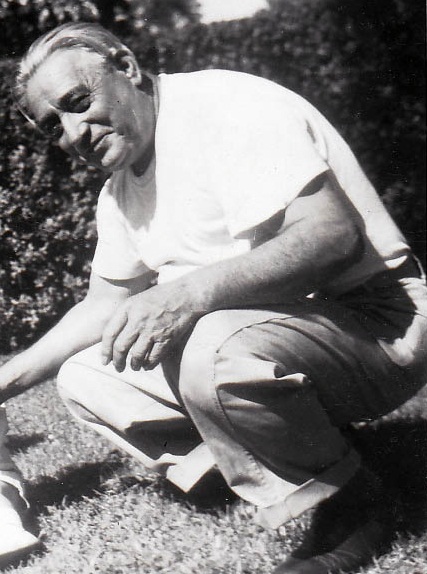
Grandpa Tom
Grandpa Tom owned the Maple Grove, a hotel/boarding house in Atlantic Highlands, NJ. We used to visit him every summer and sometimes at Christmas, from what I can recall. On the summer trips my parents would usually stay for a week and then return to NYC, while I would stay on for several more weeks with my cousins. Getting to Atlantic Highlands from the Inwood neighborhood of Northern Manhattan, without a car, was quite an adventure during the 1940’s, and to my 5 and 6 year old mind, seemed to consume most of the day.
Those summer excursions involved several modes of transportation: subway, taxi, boat and car. My mother, father and I took the A train from 207th Street to 42nd Street, then a cab from 8th Avenue to 12th Avenue, where we boarded a Hudson River Day Line steamboat such as the Chauncey M. Depew, the Peter Stuyvesant, or the Robert Fulton. These excursion steamships took us down the Hudson River, past the Statue of Liberty and Staten Island, out into Lower New York Bay, and then, with Sandy Hook off to the port side, into Raritan Bay. The boats docked at the pier, a long, rickety (to a 5 or 6 year old boy) wooden pier that jutted out into Sandy Hook Bay, where Grandpa would meet us on the pier with his big black car and drive us to his hotel. The pier is long gone and has been replaced by a new marina which offers fast ferry service to NYC.
Besides bringing me to see Grandpa, the excursion boats brought vacationers to the Jersey Shore and gamblers to Monmouth Park Racetrack. In addition to Grandpa’s car waiting for us on the pier, there were numerous buses to take the gamblers to the Racetrack, and Jersey Central trains to take the vacationers farther down The Shore.
Each summer, as the calendar inexorably moves from July into August and fresh, locally grown, tomatoes begin to make their appearance at farm stands and markets, and the scent of fresh grown basil fills the air of our kitchen, I return in my mind to those idyllic summer days in Atlantic Highlands with Grandpa Tom. The combined perfume of tomatoes and basil acts upon me as did the taste of a madeleine act upon Proust, bringing me back to the kitchen of the hotel, where Grandpa has just picked the tomatoes from his garden, shred the basil picked from his plants, and mixed the two together with garlic, olive oil and salt to make his tomato salad. For further reading on memories triggered by certain foods see How to Cook Like an Italian Grandmother.
My mother continued the tradition of making this summer delight and I carry it on from her. Our family and friends now enjoy Grandpa Tom’s Tomato Salad and all agree that the best part is sopping up the juice with crusty Italian bread after the tomatoes have been devoured. I hope that you enjoy it as well and it causes you to think about some of your own childhood food memories.
Another reader recently asked about shrimp and what to do with it. Shrimp to my mind has practically no flavor at all, just texture. Brother Devil, the next article, will show how to compensate for the lack of flavor in shrimp!
Biloxi, Dixie beer, Fish, Keesler AFB, Leghorn, Livorno, Red Snapper, Red Snapper alla Livornese, tuscany
In General Articles on July 11, 2011 at 10:01 PM
Growing up Catholic in the 1940s and 50s, meatless Fridays were obligatory. As a result, fish in some form or another, was invariably on the menu. Because fish usually meant some type of fried or frozen denizen of the sea, which when defrosted and ‘cooked’ tasted more like cardboard, meatless Fridays truly were a sacrifice. That is unless it was my father’s turn in the kitchen and he would cook his specialties, either Spaghetti with Del Monte Sauce or Linguine with Cauliflower Sauce, neither of which engendered much of a sacrifice on the part of me or my sister.
It wasn’t until I was on active duty in the Air Force and stationed at Keesler Air Force Base in Biloxi Mississippi, that I realized that fish could be caught and served fresh, did not have to stink, and actually could be delicious. The first such discovery was at a restaurant on the bayou that specialized in freshly caught, fried catfish, French fries and Dixie beer. It was an epiphany for this New York City born and bred boy and I loved every meal there.
Eventually, I worked up the courage to try other species of fish and other styles of preparation. Today, I will eat pretty much any type of fish and enjoy it baked, blackened, broiled, fried, poached, smoked, or raw in sushi and sashimi. Both the French and the Italians have ways of preparing fish that will soon make you forget that it was ever a sacrifice to abstain from meat. Today, on those rare occasions such as Ash Wednesday, Good Friday and all other Lenten Fridays, when most Catholics must abstain from meat, which my wife will insist that we do, I readily agree and prepare a fish-based meal that when being consumed makes me smile at the ‘sacrifice.’
One poaching method for fish that is particularly delicious, is ‘alla Livornese,’ i.e., in the style of Livorno, Italy. Livorno, also known as Leghorn, is a seacoast city in Tuscany. The term, alla Livornese, usually means that it is cooked with tomatoes and is spiced up with garlic, onion, capers and olives. For Red Snapper alla Livornese I use a combination of fish stock or clam broth and white wine as the poaching liquid. If you cannot find Red Snapper, any firm fish such as Striped Bass or Swordfish will work just as well; simply adjust the cooking time, depending upon the thickness of the fish. I usually figure 8 to 10 minutes for Red Snapper, 12 or so minutes for Striped Bass and up to 15 minutes for Swordfish Steaks.
For a variation, try baking your fish oreganata style, see: Striped Bass Oreganata for the basic oreganata preparation. Another excellent method of cooking fish is grilling it, especially on a cedar plank, see: Cedar Plank-Grilled Glazed Wild Salmon. Swordfish steaks also lend themselves to great summer grilling and Pineapple Mango Salsa goes great with Grilled Swordfish. Poaching also works particularly well with stuffed fish like sole, Fillet of Sole Stuffed with Crabmeat and Shrimp. With summer in full swing and fresh local tomatoes becoming available, I think that you should continue your reading with: Memories of Summer at The Shore.
capers, olives, Red Snapper alla Livornese
In Fish, Recipes, Seafood on July 11, 2011 at 10:00 PM
Ingredients:
• 2 fillets of Red Snapper, Striped Bass or other firm white fish
• 4 Tbsps. extra virgin olive oil
• 2 Tbsps. minced garlic
• ½ cup finely chopped onion
• 4 Tbsps. capers drained
• 1.5 cups of whole pitted olives, green and black mixed
• 1/3 cup dry white wine
• 2 cups coarsely chopped tomatoes, drained
• ½ cup fish stock or clam juice
• ¼ cup chopped parsley
Preparation:
1. Heat the olive oil on medium, in a non-stick pan with a cover and large enough to hold the fillets side by side.
2. Add the garlic and onion and sauté lightly for 2 minutes, do not let it brown.
3. Add the capers and olives and cook for two more minutes.
4. Add the white wine, turn the heat to high and bring to a boil.
5. Add the tomatoes, stir for 30-45 seconds, then add the fish stock or clam juice.
6. Add the fish fillets, cover and poach 8 to 10 minutes for Red Snapper; 10-12 minutes for Stripped Bass, depending on thickness.
7. Remove the fish to plates, sprinkle with the parsley and pour the sauce over the fish.
Serve with steamed or boiled, buttered new potatoes and a simple salad.
See Related Article
Braising, Calvados, Granny Smith Apples, Pork Chops, Raisins
In Meat, Pork, Recipes on July 6, 2011 at 3:27 PM
Preparation and Cooking Time – 1 hour
Ingredients:
• 6 boneless, center cut pork chops, about 3 lbs., patted dry
• 5 Tbsps. of unsalted butter
• ¼ cup of flour
• Freshly ground black pepper
• Kosher salt
• 1 cup raisins
• 3 Granny Smith apples, cored, skins left on, cut in half vertically, each half sliced in the opposite direction, into ¼ inch slices
• 2 Tbsps. sugar
• 1 large shallot, chopped fine, about 6 Tbsps.
• 1 cup Calvados
• 1 Tbsp. chopped fresh sage, about 12 leaves
• 1 Tbsp. chopped fresh rosemary, about 1 stem
Preparation
1. Add the raisins to two cups of boiled water and let soak for 30 minutes while performing the other steps. After 30 minutes, strain the raisins and set aside.
2. Heat 2 Tbsps. of butter on medium heat in a large (14 inch) non-stick pan. When the butter begins to bubble, add the apples cooking and turning them periodically for 6-8 minutes until they begin to release their liquid. Add the sugar and stir, continue cooking and turning frequently for an additional 20 minutes, until well caramelized.
3. While the apples are cooking and the raisins are soaking, add the flour, salt and pepper to a one gallon-sized Ziploc bag. Then add the pork chops two at a time and shake well to coat the chops.
4. Add the remaining 3 Tbsps. of butter to a stainless braising pan or covered skillet and heat on high.
5. When the butter begins to bubble, add the seasoned pork chops in one layer and brown on high heat for 3 minutes, turn and brown the other side for 3 minutes more.
6. Reduce heat to medium-high. Add the chopped shallots and continue browning the chops for 6 additional minutes, turning after 3 minutes.
7. Shut the heat and add the Calvados, turn the heat to high to boil off the alcohol, add the caramelized apples and strained raisins, cover and let braise for 8 minutes, turning the chops after 5 minutes.
8. Remove the cover, add the chopped herbs and cook for 2 minutes more.
Serve with new potatoes roasted with olive oil, rosemary and kosher salt, and a green vegetable such as buttered peas and shallots or Brussel Sprouts Roasted with Hazel Nuts.
Please see Midnight (and Calvados) in Paris.
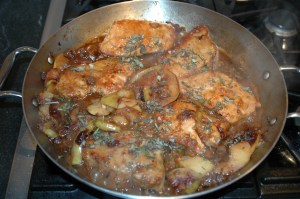
Braised Pork Chops with Calvados, Apples and Raisins
Apple Brandy, Apples, Cafe, Calvados, Ernest Hemingway, Midnight in Paris, Montmartre, Normandy, Paris, Pork Chops, Woody Allen
In General Articles on July 6, 2011 at 3:07 PM
It wasn’t until 1991, on my first visit to Paris, that I tasted Calvados. I had read about the famous apple brandy from Normandy in Hemingway’s books and had seen it being drunk by characters in the French films to which I was addicted in the 1950s and 60s. But I never had the occasion to order it, until actually sitting in a Parisian café in Montmartre, where it was the natural thing to do.

Montmartre, December 2, 2005
I had it again on subsequent visits to France, in 1992 when we visited our older daughter who was doing a semester abroad in Aix en Provence, where I sipped it watching the pedestrian parade along the Cours Mirabeau and again in 1999, on a trip to the Languedoc-Roussillon region and the Canal du Midi. The most recent occasion had been in 2005 in Paris where we celebrated our wedding anniversary. That time I brought a bottle of it back home with me. That bottle had been sitting unopened on my liquor shelf ever since, that is until last week.
Recently my wife and I saw the latest Woody Allen film, Midnight in Paris and, as was the case with the French films of the 50s and 60s, the characters were drinking Calvados. That’s when it hit me that I still had that imported bottle of Calvados, and it might be interesting to use it for cooking. So I began thinking…what goes well with apples, the essence of Calvados? Pork immediately came to mind, pork chops or roast pork is usually accompanied by applesauce, so voilà, pork chops and Calvados!
Okay, well then maybe I should also add apples to give the dish some substance, that way I can skip the side dish of applesauce. Next, I thought, caramelized apples would make it even sweeter. My wife joined the production by suggesting that I add raisins as well, since they frequently appear as a sweetener in gravy for baked ham.
This was beginning to come together; all it needed now was some herbs to further enhance the dish. That part was easy, sage and rosemary each have a natural affinity to pork, thus, emerged my plan. Now it was just a matter of executing that plan and putting it all together.
I hope that you enjoy the result, Pork Chops Braised in Calvados, Caramelized Apples and Raisins, we certainly did! One of our readers recently asked for some fish recipes. Lest I be accused of having ichthyophobia please continue reading at: Fish is not Just for Fridays, Anymore.
artichoke hearts, chicken, Italian sausage, oregano
In Chicken, Meat, Recipes on June 18, 2011 at 11:16 AM
Ingredients:
10 cloves of garlic, sliced thin
10 sweet Italian sausages
12 boneless and skinless chicken thighs
2/3 cup of flour
Freshly ground black pepper to taste
1/3 cup + 3 tablespoons of extra virgin olive oil
2 cups of dry white wine
3 12 oz. jars of marinated and quartered artichoke hearts with their liquid
5 sprigs of fresh oregano, leaves removed and chopped
Steps:
1. In a large stainless steel frying pan, heat the 3 tablespoons of olive oil on medium heat, add the sausages and brown them until substantially cooked, about 25 minutes. When done, remove them from the pan, let then cool and then cut them into ¾ inch pieces, set aside. Pour off the liquid fat, but leave the frond. Deglaze the pan with one-half of the wine, pour it off the liquid and reserve for step 6. Clean the pan.
2. While the sausages are frying, add the flour to a one-gallon sized zip lock bag and add the black pepper.
3. Pat the chicken pieces dry with a paper towel and add them, 3 pieces at a time, to the bag. Seal it and shake it well, thoroughly coating the chicken.
4. After all the chicken pieces are floured, add the olive oil to the cleaned frying pan and heat it on medium high, add the garlic and saute until dark brown then remove the garlic.
5. Add the floured chicken pieces without overcrowding them and brown on medium-high for 6 minutes, then turn them and brown for 6 minutes more. (Note, Depending on the size of your pan, you may have to do this in two batches, or use 2 pans for the chicken.) When the chicken is cooked, remove it from the pan or pans and deglaze with the remaining wine.
6. Return the chicken to the pan, bring the wine to a boil and cook for 3 minutes, then reduce the heat to medium, turn the chicken, add the sausage pieces and their reserved liquid and continue cooking for 3 minutes.
7. Add the artichoke hearts and their liquid to the pan. Raise the heat to high and cook for 5 minutes turning the chicken once or twice.
8. Add the oregano; let the flavors blend by cooking for another two minutes or so while turning the chicken and sausages several times.
Note: This recipe makes enough for about 6 people and can be prepared in advance and reheated.
See Related Article
Anna Maria Volpi, Artusi, Gino's Cafe Restaurant, Pellegrino, Pellegrino Artusi
In General Articles on June 18, 2011 at 10:46 AM
One of the interesting things that I have discovered about Italian cooking is that unlike French cooking, and notwithstanding the opus of Pellegrino Artusi, The Science of Cooking and the Art of Eating Well, there does not appear to be a codification of recipes for Italian cuisine. This is explained very succinctly by Anna Marie Volpi on her website.
The first time I had Chicken Scarpiello was at a now defunct neighborhood restaurant on Allerton Avenue and Boston Post Road in the Bronx. During the 1970s and 80s, we used to visit Gino’s regularly, it had good food, a decent wine list, reasonable prices, a lively crowd and valet parking. What more could one ask for? Maybe the food wasn’t particularly adventurous and perhaps the chef wasn’t a celebrity, but the place was reliable. I never had a bad meal at Gino’s, R.I.P.!
Their Chicken Scarpiello was served, with its skin, on the bone, making it very moist, but difficult to eat and a bit too greasy for my arteries. But they served it with sausage and that, in my opinion made it special…as a matter of fact, anything with sausage is special (be sure to check out my Orecchiette with Broccoli Rabe and Sausage.)
The next time I saw Chicken Scarpiello on a menu, I ordered it fully expecting to see it come out like Gino’s. This time there was no sausage, and I, in my naiveté, inquired of the waiter as to what happened to the sausage. His haughtily delivered reply was that Chicken Scarpiello was NEVER served with sausage; my first lesson in the vagaries of Italian cucina.
After several more restaurant disappointments with Chicken Scarpiello, I developed my own recipe, Chicken Scarpiello alla Chef Scar,and now I will share it here. This recipe went through several iterations with the chicken, as I struggled to find the right combination. I started with chicken breasts and wanting to reduce the grease level, I first removed the skin and quartered the breasts, but that still left the little bone particles. Next I tried skinless, boneless, chicken breasts, also known as chicken cutlets, but upon cooking they dried out too soon. Realizing that chicken thighs might retain their moisture longer, I substituted skinless thighs in the next development stage. This was a great improvement and since the thighs only had a large bone, this solved the splintered bone issue. Then I discovered skinless, boneless, chick thighs and found the right combination.
What’s next you ask, how about some more pork. After all, it is ‘the other white meat’. Check it out at: Midnight (and Calvados) in Paris
Asparagus, Boneless Shell Steaks, Bordeaux, Saint-Emilion, Steak, Steak au Poivre
In Beef, Meat, Recipes on May 23, 2011 at 7:26 AM
(Adapted from the New York Times Cookbook by Craig Claiborne)
This dish cooks very quickly, in less than 15 minutes and requires constant attention; therefore it makes sense to have all of the ingredients measured out and readily at hand before beginning to cook. DON’T FORGET THE MATCHES – PREFERABLY LONG FIREPLACE MATCHES.Use a heavy, cast iron frying pan for up to three steaks; cooking four will most likely require two pans, making it necessary to divide the other ingredients accordingly. This preparation also produces a lot of smoke so be forewarned.

Have Everything Ready
Ingredients:
• 1 boneless shell steak per person, each about 1¼ inch thick, excess fat trimmed
• Freshly ground black pepper
• Kosher salt
• 1 pat of unsalted butter per steak + 1 extra pat for the sauce
• Tabasco Sauce
• Worcestershire Sauce
• 2 Tablespoons of ReaLemon juice per steak
• ¼ cup of cognac (for 1 to 3 shell steaks; increase to 1/3 cup if preparing 4 steaks)
• 1/3 cup of heavy cream (for 1 to 3 shell steaks; increase to 1/2 cup if preparing 4 steaks)
Steps:
The following instructions are for medium rare steaks. If the steaks are of a different thickness than 1¼ inches, or are to be served other than medium rare, cooking time should be adjusted accordingly.
1. At least 30 minutes prior to cooking, remove the steaks from the refrigerator and pat them dry with paper towels to remove any moisture. Pepper them liberally with freshly ground black pepper. Softly press the pepper into the steaks with a wooden mallet or spoon and let them sit at room temperature until ready to cook.
2. Heat the cast iron frying pan on high for 2 minutes.
3. Lightly cover the bottom of the pan with kosher salt and heat for another full minute.
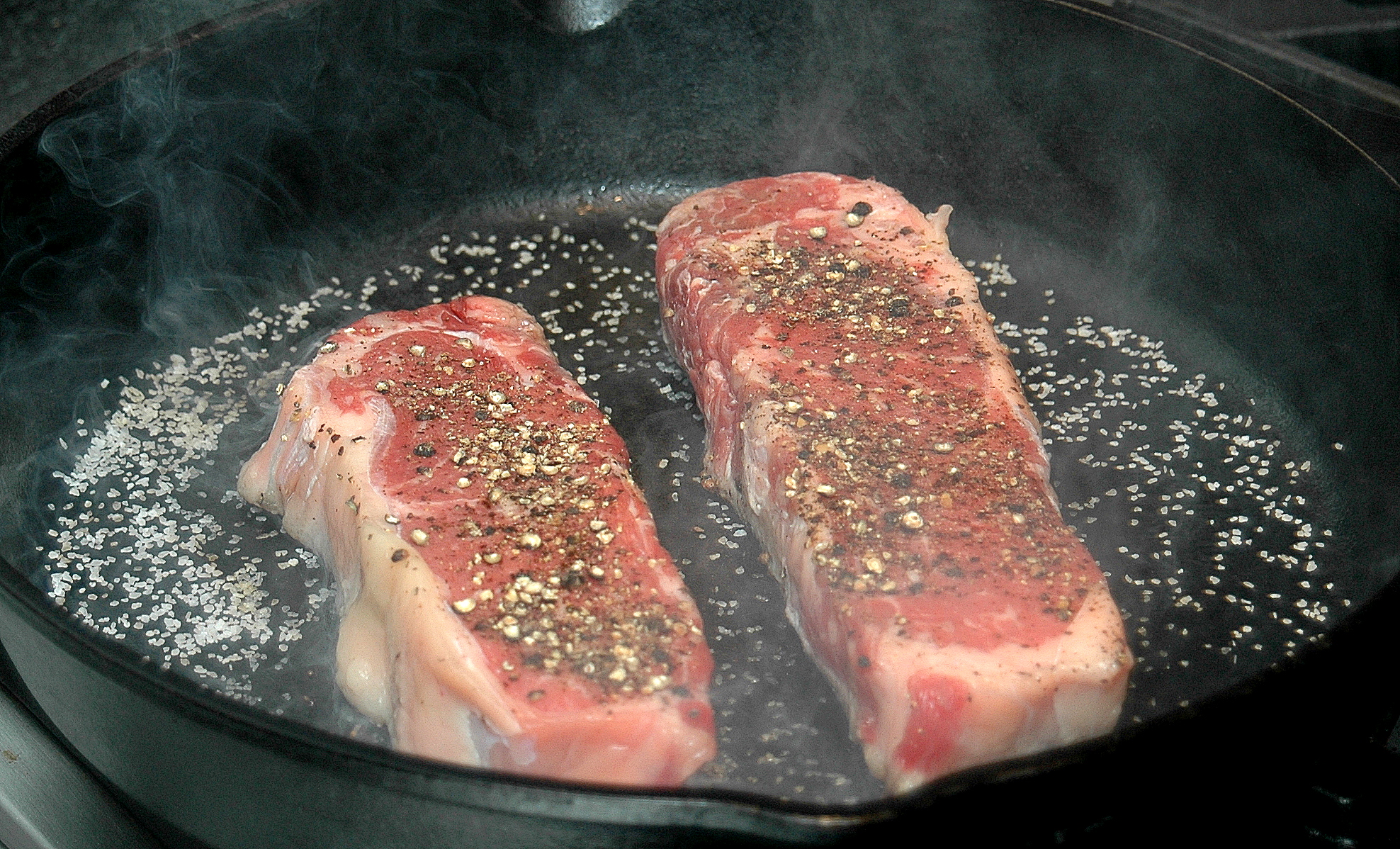
4. Add the steaks to the pan and sear for 2 minutes on each side.

Searing the Steaks
5. Lower heat to medium, continue cooking the steaks for an additional 6 minutes for medium rare (4 minutes for rare), turning them in approximate one-minute intervals.
6. After the 10 minutes, (or 8 minutes for rare) place one pat of butter on each steak, spread the butter around with a fork in order to melt it into the steaks. After 30 seconds, turn the steaks and cook for another 30 seconds. By this point the steaks will have cooked for about 11 minutes (9 minutes for rare).
7. Sprinkle each steak with 4 shakes each of Tabasco Sauce and Worcestershire Sauce turn the Steaks and repeat the process. Add 2 tablespoons of the ReaLemon juice per steak and continue cooking and turning the steaks for no more than 1 minute.
8. Shut the heat, add the cognac and let sit for about 5 seconds; stand back and ignite the cognac with the fireplace match. (Note: This will produce a high blast of flame, so be sure that no curtains, towels, rags or other combustibles are nearby and if you have the vent fan on, shut it first). When the flame subsides, turn the heat to high again and turn the steaks once or twice to coat them well with the sauce, transfer the steaks to warmed plates and shut the heat. By this point the steaks will have been cooked for 13 minutes (for rare steaks, about 11 minutes).

Flambe with Cognac
9. Add the cream to the pan, turn the heat to medium and scrape the bottom of the pan with a wooden spatula. Add one pat of butter; continue stirring, scraping, and cooking the sauce until it bubbles and turns a medium to dark caramel color.

How the cream should look
10. When the sauce thickens to the point of coating the back of a spoon, remove it from the heat and pour equally over each steak.

The Finished Product
Serve at once. Great accompaniments include Broccoli Florets or Asparagus sautéed in garlic and oil, a loaf of crusty French bread to sop up the remaining sauce and a bottle of fine Bordeaux, such as a Saint-Emilion.
See Related Article
Antoine's, Biloxi, Brennan's, Galatoire's, Hurricanes, Montmorency Falls, New Orleans, Pat O'Briens's, Preservation Hall, Quebec City, Steak au Poivre
In General Articles on May 23, 2011 at 7:01 AM
I don’t think I had ever tasted French cuisine until I was stationed at Keesler Air Force Base in Biloxi Mississippi. No, even though the Air Force is reputed to eat better than the Army, Navy and Marines, French cooking was not in the repertoire of the mess hall sergeant and his cooks at Keesler; that treat was to be experienced in the city of New Orleans, which lies 90 miles to the west of Biloxi and was our escape destination whenever we had the money and a 48 hour pass.
New Orleans in the 1960s was divine, especially after a couple of weeks cooped up on the base. Waiting to be discovered were such renowned restaurants as Antoine’s, Brennan’s and Galatoire’s, along with Dixieland Jazz, Hurricanes at Pat O’Brien’s, Jambalaya at The Court of the Two Sisters, and Beignets at Café du Monde, which tasted particularly delicious accompanied by an espresso at four in the morning.
Steak au Poivre (with Pepper), Oysters Rockefeller and Banana’s Foster, comprised my introduction to French style cooking in New Orleans. I was used to having steak at home, cooked in the oven by Big Mike; although usually rare on the inside, it was grey on the outside, chewy and not all that interesting. Steak served with a delicious sauce was a revelation.
Several years later, I learned to prepare it myself after first following the recipe in The New York Times Cookbook, authored by Craig Claiborne. Subsequently, after many additions, deductions and consultations with other home cooks, I perfected what was then my recipe. It was a staple in our family until 1986, when I had a eureka moment.
During the summer of 1986, my wife and I took our two daughters to Quebec City for a week’s vacation. It was my fourth visit to that beautiful city and my wife’s second. Quebec City has a distinctively European atmosphere. For the girls, it was their first trip outside of the country and would serve as a foretaste of what they would later see and experience in Europe. We stayed at the Chateau Frontenac in a suite overlooking, and high above, the St. Lawrence River. After each day of sightseeing in the city, or taking side trips to Chute Montmorency, the Shrine of Ste-Anne-de-Beaupré, the foothills of the Laurentian Mountains, or the Ile d’ Orleans, we strolled the streets of the city, perused the menus in the windows and chose a restaurant for dinner.
For each of the first six nights, we selected a different restaurant in which to eat. My wife, our older daughter and I ordered varied meals in each, but our younger daughter, who was 9 at the time, ordered the same thing every single night…Steak au Poivre! That was the only French dish that she knew and clearly loved, so to her way of thinking, why experiment and wind up with something yucky?
On our last night, having pretty much exhausted the restaurants that were most appealing to us, we asked the ‘Steak au Poivre girl’ which restaurant had the best. Unhesitatingly, she proudly selected one and that’s where we went. The sauce on the Steak au Poivre was different from what I had been making for the previous 18 or so years, it had cream in it! That was my epiphany. Cream was not in Craig Claiborne’s original recipe, with which I had started and from which I had adapted mine. To my palate it was what had been missing.
This recipe for Steak au Poivre has been served to family and friends for almost 25 years and I am happy to share it with you. From beef, we move on to ‘the original white meat’ chicken at: Chicken Scarpiello; Everybody Makes it Differently!
Balsamic Vinegar, Boneless Center Cut Pork Chops, Cherry Peppers, near east pearled couscous, Roasted Peppers, sauteed broccoli rabe, Wondra Flour
In Meat, Pork, Recipes on May 13, 2011 at 9:35 AM

Quick, easy and delicious!
Ingredients:
• 6 boneless center cut pork chops, about ¾ inch thick, approximately 2.75 – 3 lbs total
• Kosher Salt and freshly ground black pepper to taste
• 3 Tablespoons of Extra Virgin Olive Oil
• 7 cloves of garlic, sliced
• 2 cups of dry white wine
• 1/3 cup of sliced hot cherry peppers, stems removed
• 2 large (35 oz.) jars of fire-roasted sweet peppers, about 4 cups sliced
• ¼ cup of balsamic vinegar
Steps:
1. Sprinkle the pork chops with salt and freshly ground pepper on both sides.
2. In a heavy stainless steel or cast iron skillet that has a cover, heat the olive oil on medium/high. (note 1)
3. Add the garlic and stir for 2 -3 minutes, do not let it brown.
4. Raise the heat to high and add the pork chops, brown for 5 minutes on each side.
5. When pork chops are browned to your liking, remove them from pan and set aside.
6. Remove the garlic and pour off all of the fat except for about 2 tablespoons.
7. Turn the heat to high, add the wine deglazing the pan, and let it boil for about 3 minutes.
8. Return the pork chops to the pan with any juice that has collected.
9. Add the cherry and roasted peppers and mix them in.
10. Cover the pan and continue to cook on high for 5 minutes, turning the chops once or twice. (note 2)
11. Remove the cover, lower heat to medium and cook for 5 more minutes turning the chops once or twice.
12. Stir in the balsamic vinegar and continue cooking for 3 minutes more.
13. Remove the pork chops and peppers to a plate and cover with aluminum foil and reduce the gravy, or add a tbsp. or two of Wondra® to a thicken to your liking.
We usually serve this dish with sides of fresh broccoli rabe, sautéed in garlic and oil and Pearled Couscous, which soaks up the extra gravy very nicely.
Note 1: If you do not have a stainless steel or cast iron skillet, which gives the best browning, use a non-stick skillet, but halve the amount of olive oil.
Note: 2: At this point, you can transfer the pork and peppers to a pot or casserole, add the balsamic vinegar to the gravy and thicken to your liking, then add to the pot or casserole and cover for up to 2 or 3 hours. The chops will continue cooking from the residual heat. Ten minutes before serving re-heat the pot and serve as above.
See Related Article
Balsamic Vinegar, Center Cut Boneless Pork Chops, Pork, Pork Chops, Roasted Peppers, Sweet Peppers, Vinegar Peppers
In General Articles on May 13, 2011 at 9:20 AM
Enough with the pasta! Now it’s time for some meat dishes – more protein and fewer carbs. Pork is promoted by its producers as ‘the other white meat‘ and like chicken, the ‘original white meat’, it is sold in many different forms: roasts, tenderloin, pork shoulder, sausages and ribs, and of course chops, either on the bone or boneless. It is also adaptable to a variety of different cooking methods: frying, roasting, broiling, braising and barbecuing.
Also like chicken it goes well in combination dishes cooked with a variety of vegetables. Different sauces and spices enhance its flavor and keep it from becoming boring. A popular Southern Italian dish is Pork Chops with Vinegar Peppers. Vinegar peppers are sweet peppers that are packed and sold in jars like roasted sweet peppers; however, they are preserved primarily in vinegar and spices. The problem is that they are not always easy to find.
As a result, we developed our version after experimenting with different types of peppers. We tried fresh peppers, both red and green, as well as jarred ones. The fresh peppers required a lot of cooking time up front and frankly added little to the finished product. Ultimately we settled on a combination of hot and sweet jarred papers. We also experimented with red wine vinegar and white wine vinegar, but found them both to be too harsh, too acidic; eventually we decided upon balsamic vinegar.
Another issue with pork, particularly pork chops, is that it tends to dry out quickly in cooking. Therefore it benefits from braising, i.e., being cooked in liquid. We chose to cook these pork chops in white wine to keep them moist and add a bit of flavor. Pork Chops with Hot and Sweet Peppers is delicious, quick and easy to make and another family favorite.
Where’s the beef? Check it out at: Steak! It’s What’s for Dinner!





 The Literate Chef