The Literate Chef

Archive for the ‘General Articles’ Category

Vegging Out & Vegging In

In General Articles, Recipes, Vegetables, Vegetarian Meals on July 24, 2013 at 3:43 PM

Summer Vegetables on the Grill

Summer Vegetables on the Grill

Growing up, mixed vegetables frequently meant boiled peas and carrots, compliments of Birds-Eye®.  Open the box of frozen “mixed vegetables”, place the contents in water, boil them to remove all flavor and nutrients, then smother them in butter and salt to make them somewhat palatable. I must admit however, that Birds-Eye®  have come a long way since the 1950’s!

With summer in full swing and Farmers Markets popping up everywhere, “mixed vegetables” takes on a new meaning. Pick up some eggplants, preferably the small Italian variety, some red peppers and a couple of zucchinis. And, if you are so inclined, add a red onion and a summer squash, but its your call.

Following is a simple recipe for grilled mixed summer vegetables:

Ingredients:

3 Italian Eggplants, cut into 1&1/2 inch cubes (leave the skin on for added flavor and crunch).
3 Red Peppers, cored, seeds removed and cut into 1-inch squares.
2 Zucchinis, sliced into thin circles (1/4 inch or less).
1 cup extra virgin olive oil
1 tbsp. Kosher salt
Freshly ground black pepper, to taste
1/4 cup chopped fresh basil

Procedure:

1. Heat a gas or charcoal grill to very hot, a covered grill is best in order to concentrate the heat.
2. Place the cut-up vegetables in a very large bowl.
3. Pour in the olive oil and toss well.
4. Add salt, pepper and basil and toss well again.
5. Place vegetables on a grill pan and roast with the grill cover closed for 25 to 30 minutes until cooked to your liking.

Serve as a side dish or main course.

As an added plus, place the leftovers in a gallon-sized Ziploc® bag and refrigerate for two or three days. Get some Italian bread with a good crust and a fresh mozzarella; slice the bread in half lengthwise, add the cold vegetables to the bottom half, cover with several slices of mozzarella add the top half and you are in veggie heaven.

Web-Logo

The Red, The White, The Green and The Yellow

In General Articles, Recipes, Seafood, Vegetables on July 7, 2013 at 5:00 PM

Quick, Colorful, Delicious and Healthful

Quick, Colorful, Delicious and Healthful

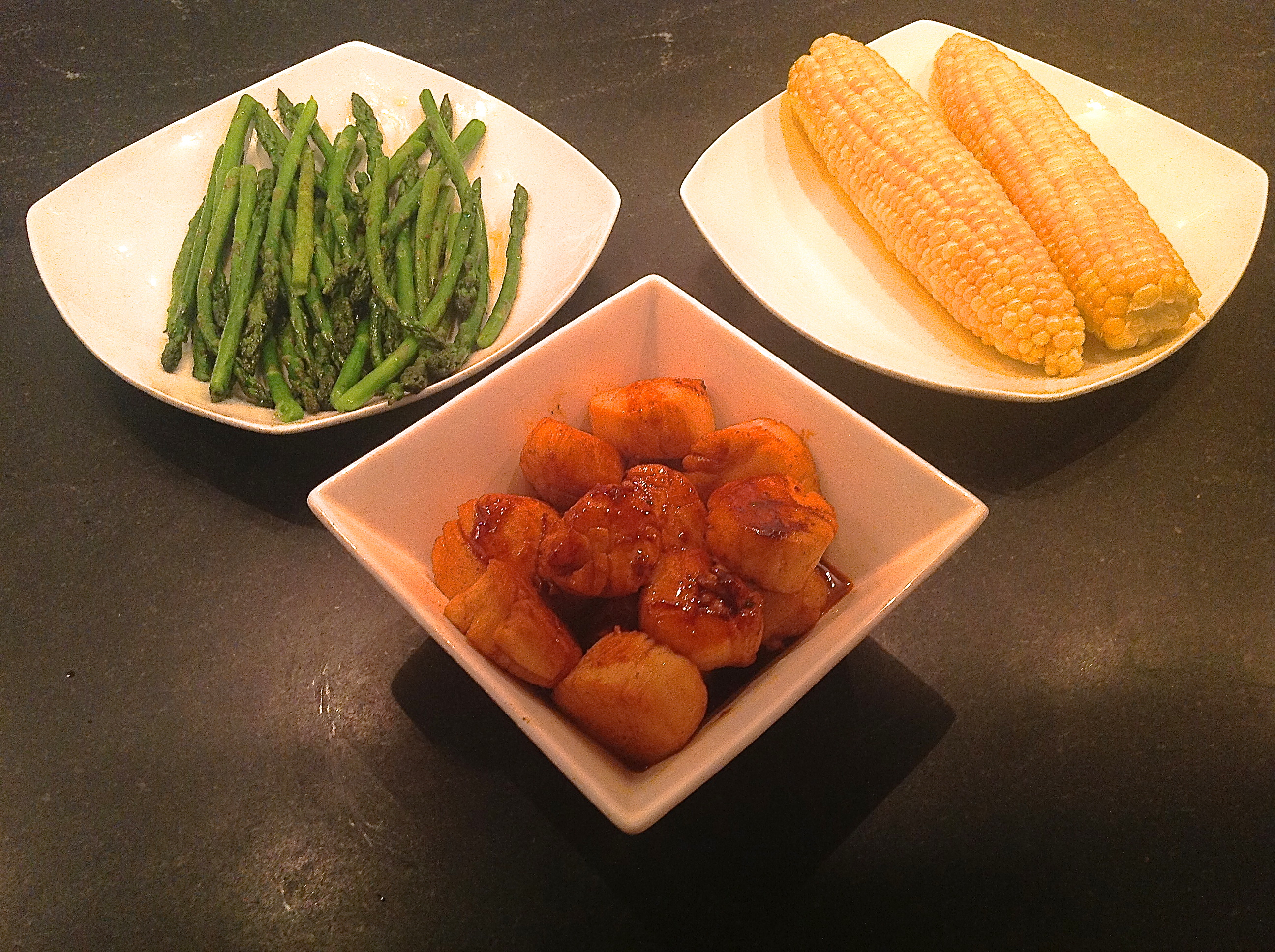
A quick summer meal in vibrant colors of green, white and yellow and red – Sautéed Scallops, Sautéed Asparagus and Corn on the Cob. What could be wrong with that combination? Absolutely nothing. It is delicious, nutritious, easy to prepare, cooks quickly and looks beautiful. That was dinner for two, one blisteringly hot and humid night last week. But with double the ingredients, it could easily become an elegant meal for guests, as long as they don’t have a shellfish allergy.

A visit that day to our local fishmonger revealed beautiful sea scallops, not the little bay scallops, which shouldn’t be sautéed because they don’t stand up very well to high heat. These scallops were fresh, sweet and had no off-putting odor. Sprinkled with paprika and quickly sautéed in butter and served with a light sauce of pan juices, deglazed with white wine, they were heavenly. The asparagus were first steamed, then quickly sautéed in garlic and oil. All while the corn cobs rested quietly in a pot of previously boiled and lightly salted water.

Dinner was ready in about 20 minutes.

Ingredients:

For the scallops:
1 lb. sea scallops
2 Tbsps. unsalted butter
2 Tbsps. Hot Hungarian Paprika
1/2 cup dry white wine and 3 Tbsps. heavy cream

For the asparagus:
1 bunch of asparagus, tough ends trimmed
5 cloves of garlic, sliced
2 Tbsps. Extra Virgin Olive Oil

For the corn:
2 ears of corn, shucked
1 Tsp. Kosher salt

Procedure:

1. Bring a large pot of water to boil. When it begins to boil, stir in the salt, add the corn, shut the heat and let the corn sit in the boiled water until ready to serve. This technique cooks the corn, but does not overcook it.
2. Dry the scallops with paper toweling and sprinkle with 1 Tbsp. of the paprika.
3. Quickly steam the asparagus, when they turn bright green remove from the pot and set aside.
4. Heat a non-stick pan on high, gently add the olive oil, when shimmering add the garlic and stir. Add the asparagus and sauté for 2 or 3 minutes retaining their bright green color. Keep warm.
5. Heat a non-stick skillet large enough to hold the scallops without overcrowding. When hot, add the butter. Just before the butter begins to brown, add the scallops, paprika-coated side down and sprinkle the tops with the remaining paprika.
6. Sauté the scallops for about two minutes, until lightly browned, turn and repeat. When cooked to your liking, (I prefer them slightly undercooked) add the wine, bring to a boil and let scallops cook  for 30 seconds more. Remove the scallops and set aside. Reduce the pan juices until by half, stir in the cream, let heat for 15 seconds.
7. Pour the sauce over the scallops and serve all immediately.

Serve with a chilled crisp Albariño or a Rosé and beat the heat.

Web-Logo

This Little Piggy Came from the Market

In General Articles on July 4, 2013 at 11:26 AM

Last month, while visiting my favorite butcher, Vincent’s Meat Market on Arthur Avenue, the “Little Italy” (a/k/a Belmont) of the Bronx, I spotted a prosciutto end, which is hard to come by in Falmouth. Thinking I would use it in a batch of Pasta e Fagioli, I added it to my meat order. But, last week with the sudden onslaught of summer heat and humidity, preparing a winter dish like that over a hot stove held little appeal and the thought of eating one held even less appeal.

Since the prosciutto was cured and vacuum packed, it probably would have lasted three or four more months in the refrigerator, at least until the onset of cold weather. However, each time I opened the refrigerator door it called out to me; after all that is its nature, to be eaten.

One of life’s greatest combinations is prosciutto, mozzarella, roasted red peppers and basil. Put those four ingredients on a chunk of crispy Italian bread, drizzle on some olive oil and you’ve got yourself perfection. But I don’t have a meat slicer, and for inclusion in a Hero (Grinder, Sub, Hoagie or whatever its called where you come from; I’m from New York so it’s always a Hero) prosciutto sliced in any way other than paper-thin would be a sin. Besides, crispy Italian bread is a rarity in Falmouth, where most bakeries are in giant supermarkets.

That tri-color combination, red, white and green, which happens to reflect the colors of the Italian flag, is perfection itself. So what else to do with the remains of this generous little pig? When all else fails, man’s thoughts turn to…PASTA!

Now for the alchemy. First, I thought I would lightly brown the prosciutto in its own rendered fat. Then, toss the mozzarella with the hot pasta letting it melt. Finally, add the prosciutto and other ingredients, and and serve it at room temperature. The execution worked well, but for two hitches, and the meal turned out to be appetizing, but perfection was not attained. I have added some footnotes to the recipe for Summer Penne, which I intend to incorporate next time. But that will have to wait until the next butcher run.

A few days later, using the remaining bit of prosciutto, I prepared a Frittata with Peas and Herbs, which served as the keystone for a delicious Sunday Brunch.

Web-Logo

Dorothea’s Homemade Hot Pepper Sauce

In General Articles on July 1, 2013 at 11:21 PM

Our supply of this hot sauce for is gone, so tomorrow we will cook up a new batch. Double this time. I am looking forward to my next bowl of “macaroni” enhanced with Mom’s sauce. It will be like going home again.

The Literate Chef's avatarThe Literate Chef

(Warning: Be sure to turn on the exhaust fan or open the window when preparing this sauce)

Ingredients:

1 cup extra virgin olive oil
6 cloves garlic, sliced
1 cup of Crushed Red (Chili) Pepper

Steps:

1.    In a heavy skillet, heat the olive oil on high heat.
2.    When it is shimmering, add the garlic, stirring constantly until it turns a medium almond color.
3.    Quickly add the Crushed Red Pepper, remove the pan from the heat and keep stirring as the pepper continues to brown.
4.    Before it begins blacken and burn, pour the sauce into a container to let cool. When fully cooled transfer it to a small jar.
5.    Top off the jar with olive oil so that there is at least a quarter of an inch of liquid on top.
6.    Refrigerate the sauce. Before using in the future, bring it to room temperature and…

View original post 24 more words

At the Farmers Market

In General Articles on June 22, 2013 at 1:24 PM

At the Falmouth Farmers Market this week, one vendor displayed some beautiful yellow tomatoes. That sight triggered a memory of a delightful and unusual Yellow Gazpacho Shooter that was presented a month or so ago, as an amuse-bouche at The Glass Onion, our favorite restaurant in town. Recalling that colorful concoction and its surprising taste and texture, I was compelled to attempt to replicate it and speedily seized the bunch of tomatoes. But, what next?

Fortunately, that evening at the restaurant, our palates were stimulated such that we inquired of the waitress what were the ingredients, other than the obvious yellow tomatoes. She willingly informed us of them but would not disclose the secret of the proportions, lest she have to have us killed. Happily, my wife had thought to jot them down in the handy Notes App of her iPhone 5. So off to the supermarket to buy sufficient quantities of the other ingredients with which to experiment.

The sighting at the Farmers Market was serendipitous, as it inspired me to get back to creating and posting. My seven month hiatus was not planned. Obviously during that period, I cooked, and I certainly ate, but for one reason or another, I just never found the time nor the desire to create and to write. Now that summer has finally arrived, after a dreary winter and a nearly absent spring, perhaps whatever malaise that affected me has ebbed.

In the meantime, since summer is the time to enjoy fresh vegetables and cold soups, I hope that you try this recipe for a flavorful and healthful Yellow Gazpacho.

Note: For our review of The Glass Onion, please click here.

With Thanksgiving but a Week Away…

In General Articles, Recipes, Thanksgiving on November 15, 2012 at 10:01 AM

…if, you are still planning your Thanksgiving menu, perhaps we can be of assistance. Last year we posted our traditional family Thanksgiving recipes; here we link them in this update, which we hope that you will find helpful.

Ready and Waiting for the Carving Knife

This year, as our long-time close friends, Marge & Dan, as well as their 3 children and their families will be joining us, we will have 22 at table. Accordingly, we will be doubling up on the Roast Stuffed Turkey with Dorothea’s Italian Sausage and Mushroom Stuffing, and tripling up on the sides of Fresh Cranberry Sauce, Bourbon Sweet Potatoes and Brussel Sprouts Roasted with Hazelnuts.

Fresh Cranberry Sauce

Roasted Brussel sprouts with Hazelnuts

In addition to sharing this special meal with special friends, we will enjoy the added bonus of a double quantity of Turkey Soup after the feast is but a happy memory.

Turkey Soup with Cheese Tortelloni

Happy Thanksgiving to all of our subscribers and readers!

What to Do with a Piece of Cod

In General Articles on November 10, 2012 at 5:47 PM

Living in New England and particularly on Cape Cod, Cod is plentiful all year long. It is healthful, not particularly expensive and, as noted, ubiquitous in the Northeast USA. So then why haven’t I previously posted any Cod recipes; because Cod, despite its many positive virtues, is basically a bland fish; and due to its flakiness, somewhat difficult to prepare.

You can’t grill it, it falls apart too easily. You can’t broil it, it dries out too quickly. You can’t marinate it, it would turn to mush. You could, of course, batter it and fry it, as in Fish & Chips, but that’s too messy for a home cook and besides would stink up the house; no, fish & chips are best left to the professionals. So what can you do with it? You could poach it and serve it with a flavorful sauce, or you bake it and do likewise, but neither of those ideas ever excited me. So Cod has been absent from my repertoire, until last night.

Inspired by a recipe for Pan-Seared Cod with Mustard Greens that appeared in a local newspaper article sent to me by my friend, Dr. A., in what he refers to as a Rochester (as in Upstate New York) Rocket, I decided to take another shot at the almighty, but troublesome, Cod. Instead of mustard greens, I thought spinach would be a tasty and photogenic compliment, and instead of a light dressing for the dish, as suggested in the recipe, I thought that a flavorful and spiced up fish broth would better do the trick.

So, off to the fishmonger for some Cod and clam juice, the latter easier to use as a base for the broth than preparing a fish stock from scratch; then, to the supermarket for spinach and the other ingredients for the broth. Frank’s article mentioned lime juice, soy sauce, ginger and shallots. The soy sauce did not appeal to me and I thought shallots would be too strong for what I had in mind. But I liked the idea of lime juice with ginger, and for a little heat I thought maybe a jalapeño pepper. Finally for a flavorful garnish, cilantro!

It worked and it was delicious, particularly with a crusty baguette and a glass of Sauvignon Blanc. So give it a try at: Pan Seared Cod Served on a Bed of Spinach – Ginger, Lime, Cilantro, Jalapeño Broth. Thanks Frank!

A word of caution, Cod being so delicate, should not be flipped. So to cook it evenly, I pan-seared it, then quickly roasted it in a very hot oven…7 minutes in total. The spatula touched the fish only twice, once to gently remove it from the pan and once to gently place it on the bed of spinach.

In General Articles on November 6, 2012 at 5:30 PM

When I first published this over a year ago, it did not contain a picture. Having prepared this dish for guests over the weekend, I had my camera at the ready and am pleased to share this update with you

The Literate Chef's avatarThe Literate Chef

(Serves four)

Ingredients:

  • 3/4 cup + 6 tbsps. of extra virgin olive oil
  • 8 large cloves of garlic, sliced thin + 5 large cloves garlic, chopped fine
  • 1 tbsp. + 1 tsp. of hot red pepper flakes (omit the tablespoon if  not all are seafood lovers, see below)
  • 2 cans (35 oz.) San Marzano Tomatoes, drained (reserve liquid) and cut-up into large chunks
  • 1-pound dried Linguine (Barilla, DeCecco or other premium brand)
  • 25 to 30 (6-8 per person) Extra Large Shrimp (16/20 to pound size)
  • ½ cup dry white wine
  • 1 cup of San Marzano tomato liquid (only if sauce is too thick for taste)
  • 30 leaves of fresh Basil

Preparation:

These steps can be performed in advance

1.    Peel and devein the Shrimp, cover and keep refrigerated until ready to cook
2.    Bring large pot of water to boil, for the Linguine
3.    Heat 3/4 cup…

View original post 456 more words

Where Have All the Germans Gone?

In General Articles on November 2, 2012 at 3:31 PM

Once upon a time German restaurants were abundant in New York City. On East 14th Street & Irving Place, there was the famous Lüchow’s, and in the Yorkville neighborhood, once known as Germantown, along East 86th Street one could find Kleine Konditorei, the Lorelei (a new Lorely Biergarten has popped up on the Lower Eastside), the Ideal Café as well as many others. There were also numerous German butchers, bakers, delis and even a famous candy store, Elk, which carried delicious marzipan and was very popular around Easter and Christmas and is now, apparently, only on-line. Thankfully, the great butcher shop, Schaller & Weber still exists.

My introduction to German food occurred at Ehring’s, a small gem of a place located on W. 231st Street in the Kingsbridge neighborhood of The Bronx. My friend, Jimmy Murphy (R.I.P.), loved the place and convinced me to try the food. I even took my future wife there on our first date. Unfortunately, like the aforementioned establishments, Ehring’s is now but a happy memory.

Hearty German fare, such as Sauerbraten, Hasenpfeffer, Kasseler Ripchen, and Wurst Platters were plentiful in those German restaurants. You never left any of them hungry, and to help wash the food down, there was plenty of fresh German beer on tap. The entire Yorkville neighborhood always seemed like a party and was a favorite destination for those of us who loved food, beer and conviviality.

Then, along came changes in the U.S. Immigration Laws and urban re-development. With the former, fewer Germans immigrated to the U.S., and with the latter, the low rise apartment houses that once harbored the German retail establishments began to slowly disappear, only to be replaced by high rise apartment houses and generic retail stores. Eventually, most of the German culture disappeared as well, having been replaced by younger non-German speaking residents. Food tastes also changed, German food was deemed to be too heavy and didn’t sit well in the new atmosphere of health-consciousness and fitness. The City is much poorer for the loss.

Finding a good German meal in the City these days is an unexpected pleasure. One such place that is still thriving is Zum Stammtisch in Glendale, Queens, where I had a superb meal a few weeks ago with friends. With the cold weather now settling in here on Cape Cod I decided to make a Sauerbraten this week. A few years ago, when we had weekend guests, Captain Jack brought his firehouse Sauerbraten, it was a treat. Jack is a retired New York City Fire Captain and a good friend. He was kind enough the share this recipe, and I hope that you will enjoy it as much as we just did.

My Cousin Vinny to the Rescue

In General Articles on October 15, 2012 at 7:42 PM

As the daylight hours grow shorter here on Cape Cod and the autumn chill creeps in, my thoughts turn to soup; and when I think of soup, I naturally think of Uncle Fred. Fred always made big batches of soup, broke them down into 1 and 2 quart containers and froze them for quick, nutritious and delicious meals for Aunt Jo and him to enjoy during the long, cold, New England winter. He usually kept one in the back of the freezer as a welcome for when my wife and I would arrive with our children for our annual August vacation in Falmouth. Even though it was mid-summer, that soup would become our first night’s meal.

One of his favorites, reflective of the large local Portuguese speaking community, was Kale Soup. It’s an amalgam of chopped kale, white beans (I used canned beans, which saves time and effort, just be sure to rinse and drain them first), Portuguese sausage and potatoes; delicious, nutritious and sticks to your ribs.  I know that Fred wrote down the recipe for me, but I was unable to find it yesterday when I went to the market to pick-up the main ingredients.

However, I did find a batch of recipes and notes from my cousin, Chef Vincent, Fred’s son. Vince’s Kale Soup is a little different from the version I concocted yesterday, he doesn’t use beans.   Nonetheless, we share a penchant for good eating, something obviously inherited from our fathers and grandfather. But I don’t ever remember Grandpa in the kitchen, Grandma did all of the cooking, so whatever skill Vince and I have in that regard, must have been passed down from her.

Here’s Vince’s take on soup:

‘There’s nothing like a nice hot bowl of hearty soup on a cold winter’s day!  I love cooking soups in the cold months (and it gets cold – for a long time – in Massachusetts!).  The aroma fills the house, and the stove keeps the kitchen warm.  It’s such a cozy feeling.  It’s even more comforting when you get to eat the finished product!  My soups are a meal in themselves.  Eat them with a nice loaf of warm bread.  Man, that’s living!’

I can’t improve on that testimony, so without further ado, check out Portuguese Kale Soup and do cook up a batch as the Autumn Leaves  start to fall.

Discoveries at The Shore

In General Articles on October 14, 2012 at 10:37 AM

On a visit to friends in Cape May on The Jersey Shore last month, I learned something new about the use of Parchment Paper. I had used Parchment Paper before, and was familiar with its non-stick properties, as well as how it allows for an easy cleanup after baking. I also knew of its use in preparing dishes en papillote. However, I did not know that it also aids in the browning of vegetables. This new use was revealed to me by our friend Lenore in her beautiful new kitchen.

Later that week as we visited with other friends farther north on The Jersey Shore, in Spring Lake, Margie served an appetizer of marinated tomatoes, which she had purchased from a local gourmet shop. They were delicious and I began thinking about how they might have been prepared. They were plum tomatoes, obviously roasted, then marinated in oil and garlic with a little parsley and basil, and probably some salt.

All the way home, after this restful and enlightening visit with friends at The Shore, as it is known, I kept thinking about the marinated tomatoes and how I would execute their preparation. First I needed to buy the parchment paper and Mason Jars.  That task accomplished I stopped at the market for the ingredients. Not being sure how far they would cook down, I bought 3 lbs. of plum tomatoes. I found the answer soon enough, they cooked down to about 1 qt., even with all of the added ingredients. I also discovered that they need to marinate for a couple of weeks in order to reach their full flavor.

The versatility and flavor of these Marinated Roasted Tomatoes makes them well worth the wait. Their rapid disappearance, however, convinced me to double the recipe in the future.

‘You can go to heaven if you want. I’d rather stay in Bermuda.’

In General Articles on September 28, 2012 at 9:57 AM

Some wonderful photos of Bermuda taken by a masterful photographer. I think that they provide an excellent counterpoint to my article: On Tour with The Literate Chef – Bermuda, Part I. The title is a quote from Mark Twain.

An Experiment in Stuffing a Roast

In General Articles on September 16, 2012 at 7:10 PM

Pork Tenderloins are a great boon to home chefs. They are pre-packaged, usually as a pair of 1 to 1.5 lb. pieces in the pack, easy to find in supermarkets and ready to cook. Sold either seasoned, with a variety of spices or marinades, or plain, i.e., unseasoned, they are tender, relatively low in fat and high in protein, and with them you can put dinner on the table in less than an hour.

We have roasted them in the oven, cooked them on the grill and cut them into medallions, but until recently, never stuffed them. Stuffing chicken or veal cutlets is pretty simple; stuffing larger pieces of meat, like pork tenderloin is a bit more complex and challenging. You need a sharp knife, a meat mallet, wax paper and butcher’s twine.

With our friends Steve and Barbara coming to dinner last week and with a package of seasoned pork tenderloins sitting in the freezer, we decided to try stuffing and roasting them. The tenderloins were seasoned with black pepper and mushrooms, so we thought that a simple, Italian-based stuffing would work well. Nothing is simpler and more favorable than the tri-colored combination of the flag of Italy, green, white and red; in this case,  fresh basil, fresh mozzarella and sun-dried tomatoes. And since the tenderloins are low in fat and hence would be dry, a white wine reduction gravy would also work well.

Having identified the ingredients all that was left was devising a plan. After slicing the tenderloins lengthwise, flattening them would be necessary as they would be too thick to stuff. And, because they are so lean, we didn’t think they would properly brown in the oven, even at a high setting of 450 degrees. So searing them in a sauté pan before stuffing seemed to make sense. That would give us the added benefit of providing a base of fond with which to make the gravy.

The process went quite smoothly and was completed, with the exception of the final roasting step, long before our guests arrived. As a result, we were able to enjoy their company with drinks and appetizers and then sit down to a delicious dinner of Roasted Stuffed Pork Tenderloin with a minimum of last minute work in the kitchen.

You Can Take it With You

In General Articles on August 5, 2012 at 12:32 PM

When my mother died six years ago, she took her recipe for Baked Eggplant Parmesan with her. As has been noted earlier, Dorothea believed in the oral tradition and hardly ever wrote down her recipes; this was one of them. It was a special Melanzane Parmigiana, in that it was neither breaded, nor floured and it contained hard-boiled eggs.  I remember it being tangy and delicious, tasting like no other “eggplant parm” and even better served cold. Her granddaughters remember it too, and they miss it and miss her as well.

So, recently, I tried to recreate Melanzane Parmigiana alla Dorothea. Mom used a basic tomato sauce with her eggplant parmesan, probably the old tried and true Del Monte Tomato Sauce doctored up. I decided to use Silver Palate’s San Marzano Marinara Sauce, doctored up. I also used the smaller Italian eggplants rather than the larger American ones, as they are less bitter. And of course, since fresh mozzarella is so readily available in almost any supermarket these days, and even on-line, I used that instead of the packaged, rubbery type. I also used freshly grated Parmigiano-Reggiano, rather than Locatelli-Romano, which she undoubtedly used.

The end result was very good, but not quite hers! Served cold, with a loaf of crusty, Italian bread it was delicious, but still not the way it was remembered. Had my memory failed me? Had I mythologized that baked eggplant, and tasted in my mind something other than the reality of the dish? My older daughter assured me that no, while my “re-creation” was very good, it was “not Grandma’s, it didn’t have that tang.”

Back to the drawing boards! Next time, I will try a little less tomato sauce (my attempt was a little too soupy), more hard-boiled egg and maybe Locatelli-Romano, instead of Parmigiano-Reggiano. In the meantime by all means follow this recipe, or make the foregoing adjustments, I can assure you that you will love it, either way. As for me, I will continue to seek that elusive Baked Eggplant Parmesan of happy memory. Maybe mom will somehow communicate the secret to me, since she did take it with her.

In General Articles on July 26, 2012 at 9:45 AM

This recipe is so good, I just had to update it after making it last night for Monica and her children. As suggested by Jeannie, try soaking the dried prunes in Calvados! I will try that the next time.

The Literate Chef's avatarThe Literate Chef

(Preparation time 15 minutes; serves 4.)

Ingredients:

2 Tbsp. unsalted butter
Pork Tenderloin, (plain, i.e. unseasoned) about 2 lbs., sliced into 1 inch medallions – You should have about 16-18 pieces
24-30 Ready-to-Serve Prunes, drained and pitted (between 1 and 2 for each medallion). As an alternative, soak dried, pitted prunes in 1 quart of boiled water. In either case reserve about 1/4 cup of liquid to enhance the sauce. Or an even better suggestion soak them in Calvados as suggested by Jeannie.
1/2 cup Calvados
Salt and Freshly Ground pepper to taste

Procedure:

1.    In a 12 inch non-stick skillet, on high heat, melt the butter.
2.    Add the Pork Medallions, sprinkle with salt & pepper to taste and sauté for 10 minutes, turning several times to brown evenly.
3.    When browned, add the prunes and then the Calvados. Shut the heat and ignite the Calvados.

View original post 107 more words

Next Post

In General Articles on July 26, 2012 at 5:49 AM

I love this picture, it could have been taken at my Grandma’s and Grandpa’s, although it was not. That could even have been me on my father’s lap, 4th in on the right! I wish that I had a picture like this from those halcyon days!

https://theliteratechef.com/2011/04/09/prologue-2/

Angela Bella's avatarItalian Harlem

Family Reunion 1947 by See El Photo
Family Reunion 1947, a photo by See El Photo on Flickr.

View original post

In General Articles on July 23, 2012 at 9:16 PM

It’s summertime and the grilling is easy, so get down to the fishmongers and get some wild salmon and have a feast. This was posted last summer but you can enjoy it anew.

The Literate Chef's avatarThe Literate Chef

(serves 4)

Ingredients:

2.5 to 3 lbs. of wild salmon fillets
¼ cup of Extra Virgin Olive Oil
1/3 cup of low sodium soy sauce
1/2 cup honey
3 tbsp. coarsely chopped fresh ginger; about 2 peeled pieces one- inch in length
2 tbsp. coarsely chopped garlic, about 5 cloves
2 tbsp. dried mustard powder
4 teaspoons Potlatch Seasoning

Procedure:

1.    Soak the cedar plank for several hours before grilling.
2.    In a medium-sized bowl, whisk together the olive oil, soy sauce and honey.
3.    Add the garlic, ginger and mustard powder and let sit for 30 minutes so the flavors blend.
4.    Remove fish from refrigerator and let sit for 20 minutes while you pre-heat the gas grill on medium. If your grill has a thermometer, you want it to be at about 450 degrees.
5.    Place salmon in a shallow non-reactive pan, skin side up and pour marinade…

View original post 173 more words

Memories of NOLA

In General Articles on July 23, 2012 at 2:03 PM

Whenever I think of New Orleans, where I spent many a weekend pass while defending the Southern Coast of the United States from an invasion by the Viet Cong, I think of food. Of course, I also think of music, drinking and having fun with my Air Force buddies, but mostly I recall the exquisite meals at Brennan’s, Antoine’s, Galatoire’s and the dining room at the Royal Orleans Hotel, as well as beignets (think unfilled zeppole) at Café du Monde at 4:00 am.

I don’t know if those memories stem from the fact that any meal outside of the Keesler Air Force Base mess hall would be memorable, or from the fact that I was exposed to the cooking of a whole different region of the country; the French, Cajun, Creole influence and the use of spices and flavors theretofore unbeknownst to me.  Whatever the reason it was a great experience and helped to influence my culinary choices beyond those learned in my mother’s kitchen. I would be remiss to not also mention Mary Mahoney’s Old French House in Biloxi, which was our local respite from the uninspiring cuisine of the mess hall.

Rémoulade is one of those new tastes about which New Orleans taught me. Apparently, it was originally a French relish-type sauce that was adapted in the Creole fashion by adding a Louisiana Hot Sauce like Tabasco, or cayenne pepper to spice it up. There are innumerable recipes for it on-line, but the one I developed is easy to prepare, takes about 10 minutes, and can be made in advance, as long as it is refrigerated.

It goes particularly well with crab cakes, which I made a few weeks ago, after picking up some lump crab meat at Costco. These Crab Cakes were a big hit with the proportion of crab meat to breadcrumbs being limited to 1 pound of crab meat to 1.5 cups of breadcrumbs. Make them, enjoy them with a cold beer, listen to some Zydeco or Jazz, or watch Treme, and ask yourself “Do You Know What It Means To Miss New Orleans?”

On Tour with The Literate Chef – Bermuda, Part III

In General Articles on July 22, 2012 at 3:52 PM

Continued From Part II

Upon returning to the hotel, we decided to have dinner at Ascot, rather than travel out to Tom Moore’s Tavern. Lunch on the first day was a preview to the excellent dishes turned out by the chef, and after-dinner drinks in the lounge rounded out a perfect day.

Day Three greeted us once again with sunshine, a light breeze and cheerful birdsong. However, this time the sun was out to stay, so after a brief committee meeting it was decided to catch the ferry out to the Royal Naval Dockyards.

But first, thanks to contacts made by a fellow NYAC club member we had lunch at The Royal Bermuda Yacht Club, where we ran into yet another fellow Club member, who with his wife had sailed up from the Caribbean on a friend’s boat.  What are the odds, bumping into several people you know, 769 miles from home? (I had neglected to mention earlier that at Bolero on the previous day, we ran into a different fellow Club member.)

Upon arriving at the Dockyards, where was berthed the cruise ship Explorer of the Seas, a leviathan of the sea at 3 and ½ football fields in length, we kicked around for a few hours, checked out the beach, the glass-works and the old fort and then stopped in at the The Frog & Onion Pub for a few refreshing pints and some good music.

We missed our ferry back to Hamilton so decided to take a taxi rather than wait around for 90 minutes. Once again serendipity stepped in, as our cab driver, Reynoldo proved to be a great guide, raconteur and poet in his own right. On previous visits to Bermuda, when we were young and carefree, we always got around the island on motorbikes. While cabs are much safer for those of us who are past middle age, they also are a better way to observe the scenery instead of focusing on avoiding a head-on collision.

The afternoon was but a prelude to the evening, because at long last, it was time to head to Beau Rivage Restaurant  where we would meet Master Chef Jean-Claude Garzia and be treated not only to the finest meal on the island, in a spectacular setting overlooking the harbor, but as an added plus would meet the Chef himself, whose talent is only exceeded by his charm.

In June 1997, Chef JC was awarded the gold medal of “Meilleur Ouvrier de France,” the highest honor for a chef in France, by then President Jacques Chirac at the Elysée Palace in Paris. The difficult and demanding contest for this award is held every four years in France. Chef Jean-Claude applied for and was accepted into the 1996 contest. He was one of 17 chefs who won the award out of 550 chefs who had competed. He did so after 20 years of training, studying and working as a chef in France, then at the Chateau Frontenac in Québec City and at the Cambridge Beaches Resort in Bermuda. In 2008, he opened Beau Rivage, for which my friends and I are very thankful.

A Perfect Bloody Mary

A 20 minute taxi ride from Hamilton, and just across the harbor, Beau Rivage is a true gem of Bermuda. From its spectacular deck, while enjoying a delicious Bloody Mary, Apple Martini, Dirty Martini or glass of wine, each of which was tested by one or more of our merry little band, you can watch the magnificent sunset and see the lights come on in Hamilton. As we discovered, the views were equally enjoyable inside.

Sunset Hamilton Harbor from Beau Rivage

After perusing the extensive and mouth-watering menu, I decided to go with two classics, a creamy Lobster Bisque and an outstanding Filet de Boeuf Wellington. Other members of our party equally enjoyed  perfect Coquille Saint-Jacques, spectacular Seafood Risotto, classic Bermuda Sautéed Rockfish and the innovative Glazed Salmon. After dessert, we got to meet Chef Jean-Claude and compliment him on his outstanding restaurant.

We spoke briefly about my efforts as The Literate Chef, after which he invited me back into his kitchen. His philosophy is that everyone is welcome in his kitchen and there are no secrets. I asked Chef JC if he would mind if I took one of his menus so that I would be able to mention in my blog the wonderful dishes that he offered. Much to my surprise, he presented me with an autographed copy of his most recent book, Bon Appétit Bermuda, which is filled with detailed recipes accompanied by beautiful photographs. Dinner at Beau Rivage was the perfect finale to our serendipitous Bermuda adventure, that had begun more than a year ago on a chilly afternoon in New York City!

Chef Jean-Claude’s inviting personality matched by his delicious dishes, the professional service of his staff, and the ambiance of his restaurant, make Beau Rivage a must place to visit on your next trip to Bermuda. In my case it will be my first stop. In the meantime, I will have to content myself with following his recipes and sharing those adventures with my readers.

A Multitude of Fishes

In General Articles on June 20, 2012 at 8:39 AM

A Multitude of Fishes

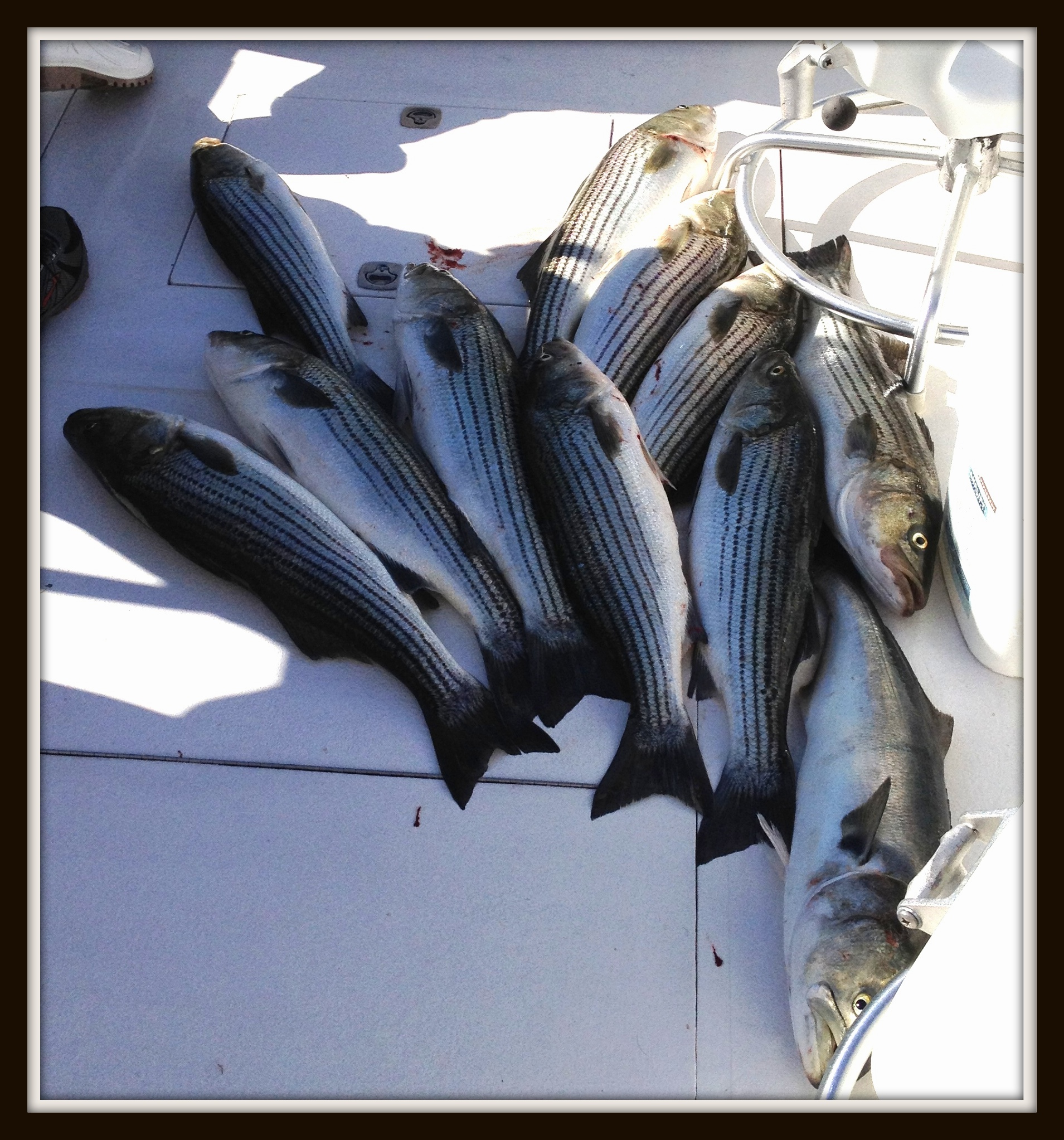
Our son-in-law went fishing out of Barnstable Harbor last Friday aboard the Lucky Lady, and, as our luck would have it, he and his friends reeled in a multitude of Stripers. He was kind enough to bring us 2 large cleaned fillets, so dinner for Father’s Day was a foregone conclusion.

Everyone offered an opinion as to how I should prepare them. After much discussion, I decided on two different methods, one Italian and the other Mexican. For the Italian preparation, Baked Oreganata style was an easy choice, since it had been so well received in the past. However, we were out of Italian Style Breadcrumbs, so I quickly mixed together my own concoction. I combined:

•    1 cup of plain breadcrumbs,
•    2 teaspoons of granulated garlic and 1/2 teaspoon of dried oregano
•    4 tablespoons of chopped fresh parsley,
•    2 tablespoons grated Parmigiano-Reggiano,
•    Kosher salt and freshly ground pepper and,
•    Enough extra virgin olive oil to blend it into a paste, which I then browned in a small sauce pan.

For the Mexican method, I reached back 20 months ago to a trip to Baja California and fishing with several friends in the Pacific, off of Cabo San Lucas, aboard  the Bob-Marlin.  On that occasion we caught Wahoo and Dorado (also known as Mahi-Mahi), which we then brought to a local restaurant that prepared them in several different styles. My favorite preparation was grilled over an open fire after marinating in a lime/cilantro combination. I decided to try and replicate that and added some minced ginger for a little kick. It was superb, but next time, perhaps, I will add a little minced jalapeño as well. For the recipe see Grilled Striped Bass in Lime Marinade.

Strawberries are in season and thanks to my friend Frank from the Finger Lakes, who sent me an article from his local newspaper on Mario Batali‘s recipe for Zabaglione, our  Father’s day dinner was concluded with a spectacular dessert, Strawberries with Zabaglione.